


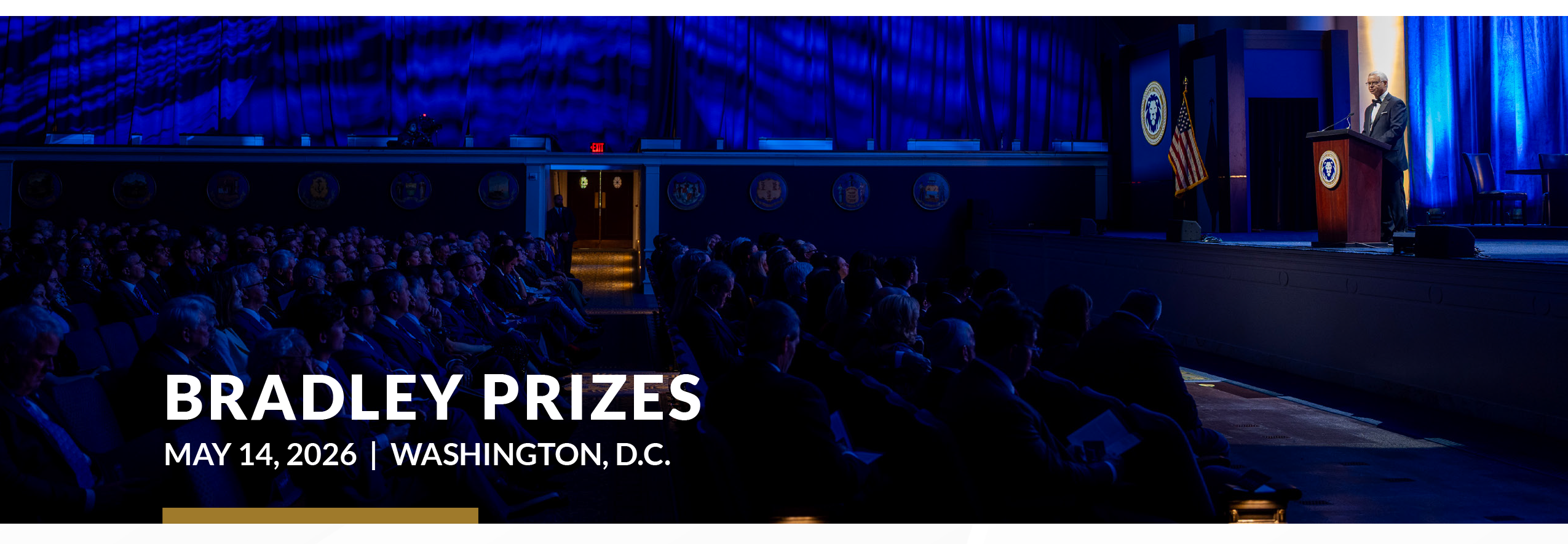
On May 14, The Lynde and Harry Bradley Foundation President Rick Graber welcomed honorees and guests to the 2026 Bradley Prizes in Washington, D.C., concluding his remarks:
The namesakes of our foundation, Lynde and Harry Bradley, understood the pillars well. They built an amazing company from modest beginnings, but they also invested in the institutions and ideals that made their success possible. The same spirit lives on in the individuals we honor tonight. As we celebrate this year’s Bradley Prize winners, let’s do more than recognize their achievements. Let’s take inspiration from them and recommit ourselves to restoring, strengthening, and protecting the principles and institutions that make America exceptional.
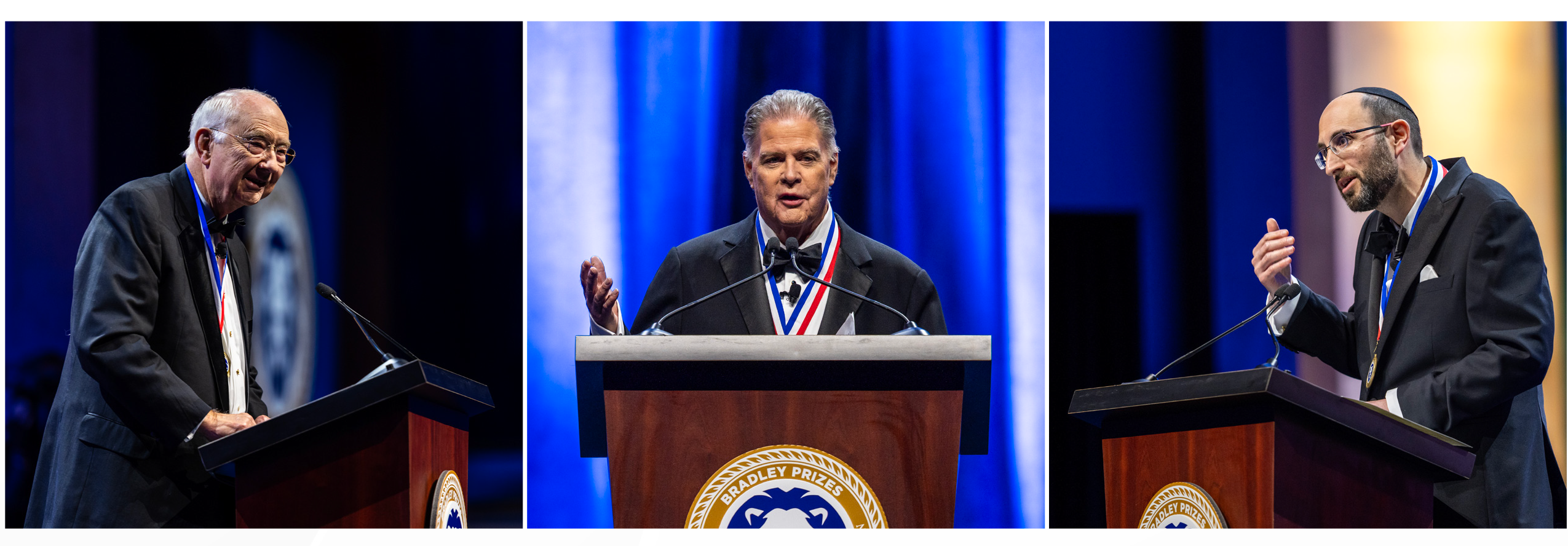
Originally an economist by training, Senator Phil Gramm has had a long and distinguished career in public service, academia, and the private sector. He is especially and fondly remembered in the Impact Fund community for having served in the United States Congress representing Texas for more than two decades, first as the representative from the 6th Congressional district, and then as Senator.
When I went to Congress, the inflation rate was 13.3%. Interest rates were 21.5%. Unemployment was the highest it had been since the Depression. And the Soviet Union was on the march all over the world. Almost twenty-five years later, when I announced I wasn’t going to run for re-election, we were in a forty-year period of price stability. The economy was humming. The budget was balanced. The Soviet Union was on the ash heap of history. And having had a little bit to do with those things, I decided there’s something to be said for quitting while you’re ahead. And so, I announced I wasn’t running for re-election.
James Hankins is a Professor of History at Harvard University and Visiting Professor of Humanities at the Hamilton School for Classical and Civic Education at the University of Florida. With a list of official and honorary titles that could fill this entire page, Hankins’s primary research interests are the history of Renaissance political thought, the history of Platonic philosophy, and the history of the classical tradition. Today, Professor Hankins leads several efforts to revitalize Western history in higher education and authentic academic freedom.
In antiquity, it was never a good idea to bet against the Romans, just as in modern times, it’s never a good idea to bet against the United States of America. This is because America, like Rome, has vast regenerative powers inherited from our Western forebears. The Romans survived the tyranny of the Tarquins, popular tumults in the early Republic, the sack of Rome by the Gauls, the invasion of Hannibal, the challenge of Mithridates, decades of civil war, the shattering crises of the third century, and even the fall of the Western Roman Empire in 476 AD. We, in this country, have also survived many crises. America, like Rome, never gives up.
Rabbi Meir Soloveichik is the rabbi of Congregation Shearith Israel in New York, the oldest Jewish congregation in the United States, and Director of the Straus Center for Torah and Western Thought at Yeshiva University. He has lectured throughout the United States and around the world on a wide array of topics related to theology, the Western tradition, and the uniquely American vision of religious liberty. He was appointed by President Trump to the Department of Justice’s Religious Liberty Commission in 2025.
For Jews and so many others to still bestow love upon Jerusalem, to still recite psalms about Jerusalem, to still sense the presence of God in Jerusalem is to say that King David lives. Bathsheba’s point is that individuals can transcend death here on Earth if the perpetuation of their most cherished beliefs is safeguarded by the next generation. And so, Adams uttered no untruth (in exclaiming on his deathbed “Thomas Jefferson survives!”). The founders do survive so long as the vision of the founding is embraced by posterity.
